
Media Observatory
Critical, responsible media.
We work to provide the media with sources of information and analysis that foster critical and responsible perspectives on the information they produce and disseminate.
We work for the psychological legacy of new generations
Our first concrete actions
We do not want to stop at planning and designing strategies and projects; we are going to start acting while we build a framework to guide our work. The problems and needs are clear.
Action 1
Stakeholder database and mailing list
We have begun building a mailing list aimed at people involved in the media, the government sector and universities. We want to invite constructive dialogue by sharing information and viewpoints that make it possible to take new positions on issues that call for fresh perspectives.
| Type of organization | Size (people) |
| Media | 941 |
| Universities | 5768 |
| Public sector | 104 |
Action 2
Statistical support
We will support the production of statistics that back objective arguments and positions against subjective claims that are taken as unquestionable truths.
2.1 Misconceptions reinforced by the media
Notion: Colombians are naturally violent
Examples: «Colombians are genetically violent», «we are the most violent», etc.
Information and statistics showing that this claim is false:
Indicators: indicadores_violencia.pdf (document in Spanish)
2.2 Balance Indicator
Design: indicador_equilibrio.pdf (document in Spanish)
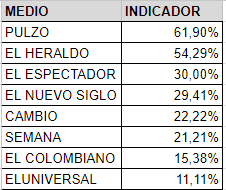
Indicator = % news unrelated to Colombia – % news related to Colombia
It subtracts the percentage of national news from the percentage of news with no connection to the country, yielding an indicator that reflects the share of “foreign” coverage unrelated to our context compared with coverage that is related to the country.
We have started working on a Balance Indicator.
A first effort to understand the content that the media are distributing to society. It is an ambitious initiative that needs to be developed in small steps.
The exercise consisted of taking the news published under the Culture/Entertainment section and classifying each item according to whether or not its content had any connection to the country.
The result of 11.11% for El Universal means, for example, that the outlet publishes 11.11% more news related to our context. Another way to see it is that, of all the news items, about 50% are national and 50% have no relevant connection to Colombia.
Measurement 1: February 2024
Action 3
Conversia, a tool to fight disinformation.
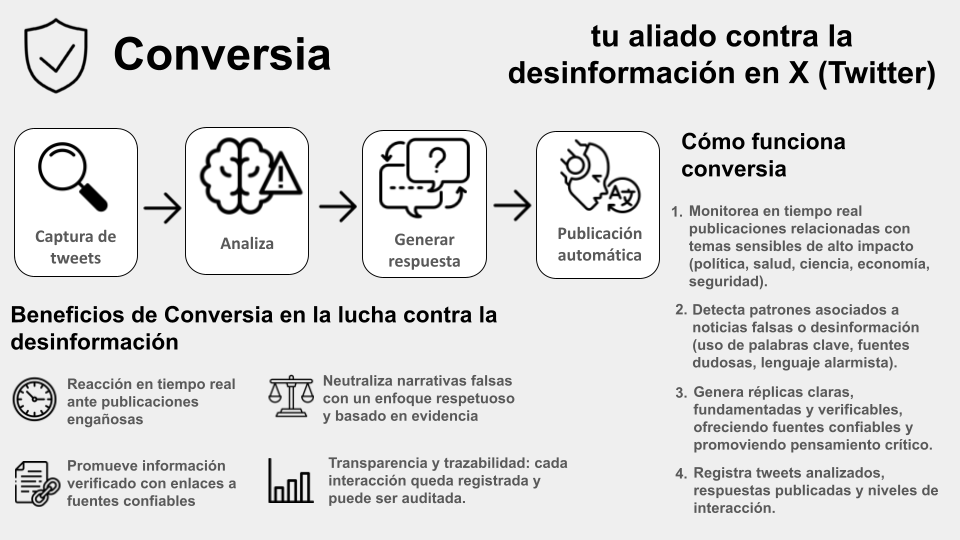
We developed Conversia, an automated solution to detect, analyze and respond to false or unfounded posts, contributing to a healthier and more trustworthy information ecosystem.
How Conversia works
- Tweet capture (Fetch): monitors, in real time, posts related to sensitive or high-impact topics (politics, health, science, security).
- Content analysis (Analyze):
- Detects patterns associated with fake news or disinformation (use of keywords, dubious sources, alarmist language).
- Integrates AI/NLP services to assess credibility and context.
- Response generation (Generate): produces clear, well-grounded and verifiable replies, offering reliable sources and encouraging critical thinking.
- Automatic publishing (Reply): responds immediately to counter the spread, keeping a respectful and educational tone.
- Database and metrics: records analyzed tweets, published replies and engagement levels, making it easier to assess impact.
How Conversia helps fight disinformation
- Real-time reaction to misleading posts.
- Promotes verified information with links to reliable sources.
- Neutralizes false narratives with a respectful, evidence-based approach.
- Transparency and traceability: every interaction is logged and can be audited.
- Flexible and scalable: from simple filters to in-depth AI analysis.
Conversia does more than automate interaction: it becomes a digital guardian of the truth, helping institutions, media and communities stop the spread of false information and strengthen trust in public debate.
Right of rectification
Rectification requests
The right of rectification is a legal mechanism that allows people to correct inaccurate or erroneous information that affects their good name or reputation in print media, electronic or digital media. In Colombia this right is backed by Law 1266 of 2008, which establishes that the correction must be made by the same outlet that disseminated the incorrect information, in the same space and with the same prominence, thereby guaranteeing citizens’ right to the truth and to their reputation.
Cringe Awards (Premios Vergüenza Ajena)
Contact
info@observatorio-ciudadano.org